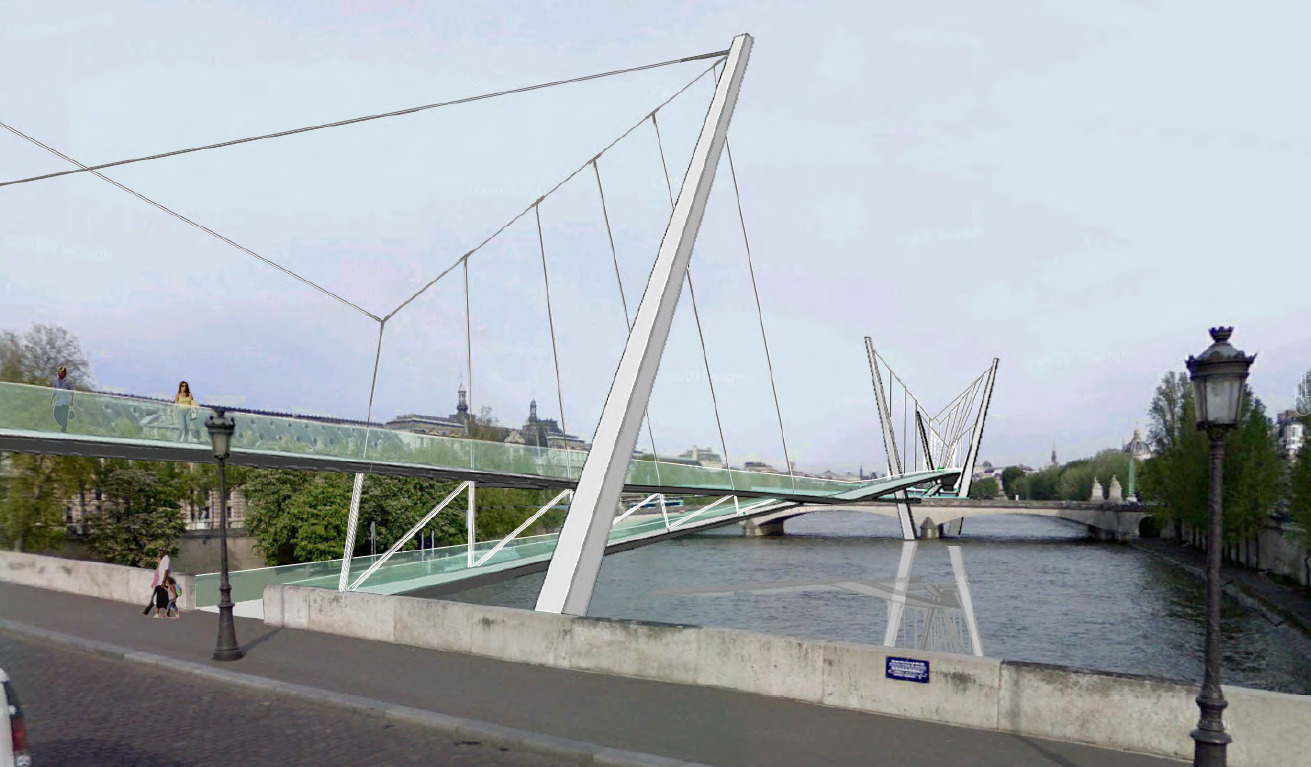
Paris Contemporary Bridge
BRIDGE:
-A structure spanning and providing passage over a gap, such as a river or a roadway.
This dictionary definition of the word “bridge” is likely to describe almost all bridge structures on Earth. It implies that the very purpose of building a bridge is defined by rationale and expediency. The task at hand was to select a site and design a new bridge- but what happens when the suggested location is a city with over 330 bridges? Do you add another one and continue to clutter river views, adding more traffic light interruptions and pedestrian crossings to an already overloaded street network?
We concentrated on the stretch of the Seine River between Pont de la Concorde and Ile de la Cite. There are already 5 crossings, which illustrate a conventional city-centric circulation where people follow a street/bridge grid that defines their route. Practically speaking, grids are inefficient- rarely providing optimal routes for residents and tourists. Conventional bridges create obstacles for traffic and pedestrians by mixing them up at intersections. In terms of aesthetics, the structures block viewing opportunities. More importantly, they do not contribute to or enhance public exposure to the river or its scenic qualities. But there is another approach.
We propose a pedestrian-centric solution; a Longitudinal Crossing- a pedestrian bridge that does not cross but spans alongside the river. The new bridge connects the existing structures along this 1.5 km stretch of the river. It begins at Ile de la Cite and ends at Pont de la Concorde, providing a unique pathway that boosts the efficiency of the existing crossings by providing a mainline path, disburdening river bank intersections and providing access to destination points along the river. It changes how residents and tourists experience the city. With this concept, the bridge evolves from a utilitarian crossing into a sustainable urban solution, addressing modern day challenges like the lack of pedestrian-oriented facilities, public exposure to waterways, traffic congestion, and the integration of rivers into the city fabric. It also establishes a new public realm and a new experience in a contemporary city. The concept of a Longitudinal Bridge is flexible and can span between 2 or 15 bridges across the river, without compromising any of its valuable aspects.

Architect:
Thea PetersenClient:
Qode InteractiveLocation:
Lisabon, PortugalDate:
November 11, 2025
Category: